Commercial real estate SEO is easier to work on when the next 30 days have a clear job instead of a giant wish list.
Should you write more articles, replace the website, or buy another marketing tool?
Let's slow down before your afternoon turns into three new subscriptions and a redesign project.
I start with the business conversation the website needs to support.
Then I work backward to the pages, information, and contact options that can help someone start it.
The plan below gives each part of that work a place in the month.
It isn't a promise that rankings or new assignments will arrive on day 30.
It's a way to make progress without turning website marketing into your second full-time job.
For the examples, picture a small brokerage that wants more conversations with property owners.
The business already has a website and some listings, but its service pages don't explain much.
This is a hypothetical planning example, not a client success story.
If that situation sounds familiar, follow the steps and adjust the workload to your team.
Finish the important work before adding more to the list.
You can build from there.
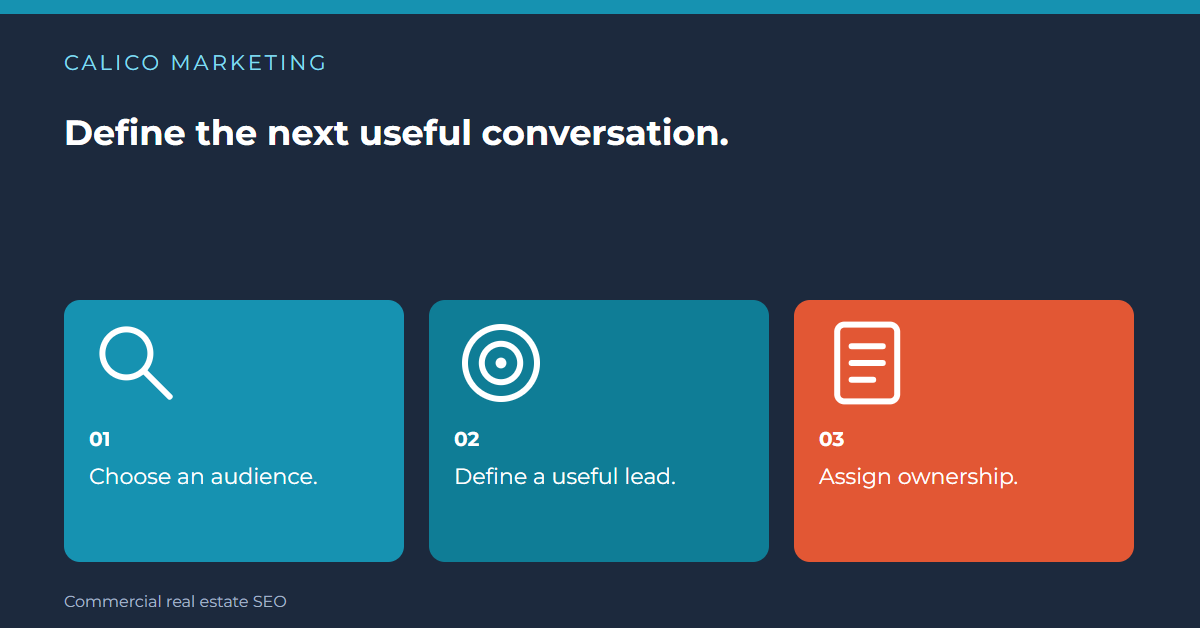
Days 1–3 should define the next useful conversation.
I start by asking what the brokerage wants the website to help someone do.
More traffic can be useful, but it is too broad to guide every decision about a service business.
I choose a primary conversation, such as an owner asking about leasing representation for an upcoming vacancy.
I then identify the audience, the property types, and the geography the team can genuinely serve.
Those details help me decide which pages deserve attention first.
For the imaginary brokerage, I prioritize its landlord representation page over a general article about commercial real estate terminology.
I don't remove useful educational content simply because it does not immediately produce an inquiry.
I give that content a supporting role and connect it to the right next step.
I also agree on what counts as an inquiry worth reviewing.
A message about a relevant property assignment is different from a supplier offering services or a student asking for homework help.
I write down those distinctions so the team evaluates the month consistently.
Finally, I identify who can approve content and who will respond when a visitor contacts the brokerage.
That gives the project a business owner instead of leaving every question in a shared inbox.
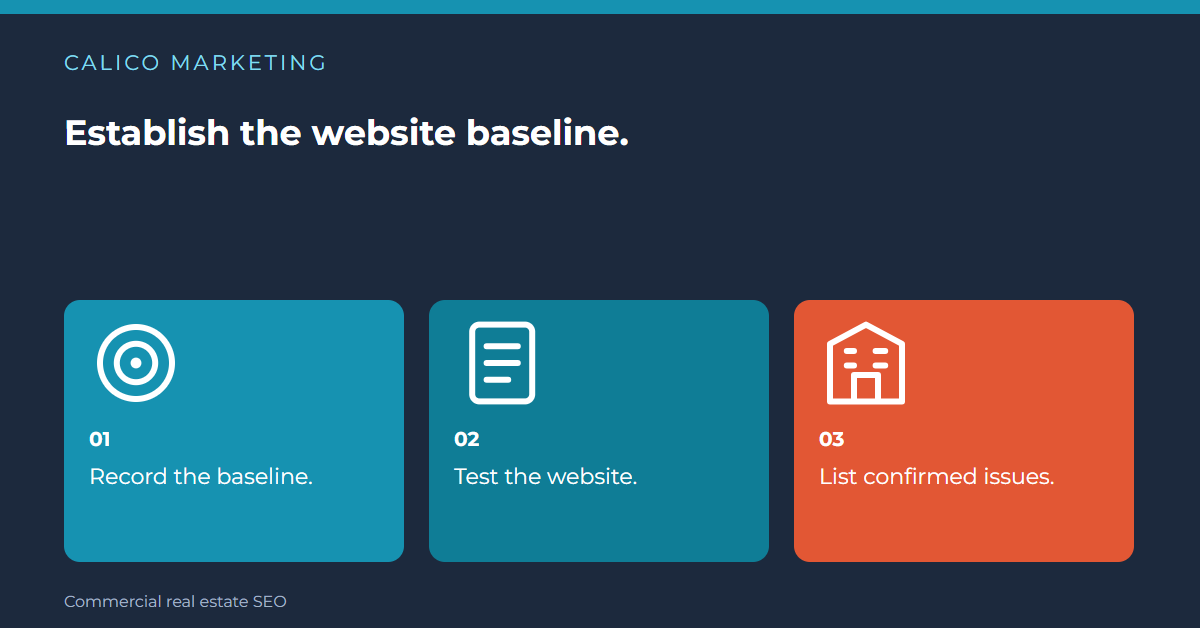
Days 4–7 should establish the website baseline.
I review Search Console, the website's analytics if available, and the brokerage's existing inquiry records.
I check which important pages appear in search and which searches seem relevant to the services offered.
I save a baseline before making changes so the next review has something meaningful to compare.
I also inspect the public website on a phone and submit a clearly labeled test inquiry.
I want to know whether a visitor can understand the offer and whether the team receives the message.
If the form fails, I fix that problem before commissioning another article.
I check the accuracy of important service details, property availability, contact information, and team profiles.
I also look for important pages that are difficult to reach through the website's own links.
I record problems in a short list with a responsible person and a practical next action.
I separate confirmed issues from assumptions that still need investigation.
For example, a low click count does not automatically prove that a headline is bad.
It may reflect limited impressions, an irrelevant query, seasonal changes, or a page that is new.
The baseline gives me better questions to ask before spending the budget.
If the first review shows that the website needs a stronger foundation, get my website design price list and compare options for different budgets.
My award-winning design experience includes more than 100 websites, and I use your actual priorities to scope the work.
Days 8–12 should improve the page closest to an inquiry.
I choose one important page and make it noticeably more useful.
For the imaginary brokerage, that would be the landlord representation page identified at the start.
I explain the properties served, the markets covered, and the process an owner can expect.
I replace broad claims with specific information the team can support.
I also make the page title and description reflect the real offer instead of trying to fit every keyword variation into one line.
I add relevant evidence, such as an authorized assignment example or a clearly attributed client comment.
I keep the contact invitation close to the explanation of the service.
If a form collects information, I ask for what the team needs to start a useful discussion.
I don't request confidential property documents through a general public form.
I explain how the team handles the next stage when detailed information is needed.
I also connect supporting articles and relevant market pages to this service page.
I rather finish one useful route to an inquiry than leave ten pages halfway rewritten.
Once the change is complete, I check the page again on mobile and repeat the form test.
That turns the improvement into something the business can use immediately.
Days 13–17 should turn client questions into topics.
I ask the brokerage team which questions come up before an owner agrees to a meeting.
Those questions often reveal what the website needs to explain more clearly.
For a landlord, a useful topic might cover the information needed before discussing a vacancy.
For a property seller, another topic could explain what to prepare for an initial brokerage conversation.
I group questions that share the same purpose instead of assigning a separate post to every wording variation.
I also check existing articles before creating a new one.
An older page that already addresses the question may deserve an update rather than a competing replacement.
I map each chosen topic to an audience, a main question, a supporting service page, and a next step.
I keep that plan short enough that a broker can review it without learning a new marketing vocabulary.
I don't treat a keyword tool's number as proof that a topic will generate clients.
I use available search evidence alongside the brokerage's experience of actual conversations.
If the team needs supporting materials, I point it toward the free brochure and offering memorandum templates.
The goal is a small, useful content queue that supports the business rather than a publishing quota nobody can explain.
Days 18–22 should produce content worth publishing.
I draft the first article around one question and answer it clearly near the beginning.
I use examples that help the reader understand the decision without inventing client stories or campaign results.
I ask the brokerage team to verify details specific to its service and process.
I include a relevant next step early enough for an interested reader to act without finishing every section.
I also include a clear author identity and useful supporting links.
If I use images, I check permission, describe their content accurately, and make sure they support the explanation.
I don't treat stock photography as evidence of a project the brokerage completed.
Before publishing, I check the page title, description, headings, links, mobile display, and contact route.
I add the page to the appropriate article index and sitemap and connect it to relevant existing pages.
If I request indexing through Search Console, I treat that as a request rather than a guarantee of inclusion or ranking.
I also check that any structured data accurately describes the visible page.
Marking up an article does not create evidence for claims that the article cannot support.
For practical examples and demonstrations, check out my helpful videos.
I publish only after the page is useful to a person who has never spoken with the business.
Days 23–26 should strengthen the follow-up process.
I review what happens after a visitor sends an inquiry or downloads a resource.
A website cannot carry the full responsibility for turning an interested person into a client.
The team needs a practical way to recognize the request, understand the context, and reply.
I identify where each inquiry arrives and who owns the next action.
If several brokers share responsibility, I make the assignment process explicit.
I don't assume a CRM integration solves this without checking its behavior.
I test whether the record includes the relevant page or property information and whether the intended person can access it.
I also review the reply message for clarity and accuracy.
It should explain the next step without promising a response speed the brokerage cannot maintain.
If the team offers a download, I make sure the file is delivered and the link works.
I keep unnecessary follow-up automation out of the way until the basic process is reliable.
For supporting materials, get free listing brochures, a sales pipeline resource, and more.
I want the first useful inquiry to become a manageable conversation rather than a test of who notices an email first.
That operational detail belongs in the plan because the website's value depends partly on what the business does next.
Days 27–30 should set priorities for the next month.
I review completed work against the starting priorities.
I confirm that the chosen service page is improved, the article is published correctly, and the inquiry route still works.
I also review any early search activity without pretending a month provides a final verdict on the strategy.
Some effects take longer to understand, and a small number of visits can produce misleading comparisons.
I examine the types of searches, the pages receiving attention, and the quality of any inquiries.
I ask the brokers what prospects understood well and what they still needed explained.
Then I choose the next few actions based on that evidence.
The next month might focus on another service page, a more useful market page, or a missing property detail.
It might also involve improving the original article instead of publishing another one immediately.
I keep a record of the changes and maintain a review rhythm the business can sustain.
If the site structure continues to make simple improvements difficult, I consider a redesign with a clear brief.
For that decision, compare my website design packages and pricing rather than guessing what a new site might involve.
I offer options for different budgets because evolving with the digital revolution should start with the work that matters most to your brokerage.
These commercial real estate SEO planning questions matter.
Will this commercial real estate SEO plan produce rankings in 30 days?
I use the 30 days to organize the work, not guarantee a ranking deadline.
The website's starting condition, competition, search demand, and implementation all matter.
I assess completed improvements first and review search and inquiry evidence over time.
Should I publish a new article every day?
I choose a publishing pace the business can support with useful, accurate content.
Daily publishing requires a queue, a review process, and reliable maintenance.
I don't sacrifice the quality of the service pages or the accuracy of existing articles to fill a calendar.
Do I need a new website before starting SEO?
I inspect the existing website before making that recommendation.
Some businesses can improve their current pages and contact process without rebuilding.
I consider a redesign when the structure or tools prevent necessary improvements from working reliably.
What should I measure if my website gets little traffic?
I track relevant search visibility alongside inquiries and their fit with the business.
I also check whether important pages are accessible and linked from the site.
Small numbers require careful interpretation, so I avoid declaring a trend from isolated visits.
Can AI help with the monthly content plan?
I use AI to organize questions, outline drafts, and support repetitive preparation.
I still verify facts, client claims, links, and the final article before publishing.
Automation should make a useful process easier to maintain rather than replace responsibility for what the website says.
Calico Marketing helps CRE businesses plan better websites.
Hi, I’m Brandy, and I’m out to take the “broke” out of commercial real estate brokerage.
I’m an award-winning commercial real estate website designer and founder of Calico Marketing, with more than 100 websites created.
My expertise is creating commercial real estate websites for brokers, agents, and developers.
I work with businesses in the United States and Canada.
I help clients evaluate CRM and property listing integration options alongside their website design.
I believe evolving with the digital revolution starts with a clear goal and technology the business can actually use.
You can get website pricing for different budgets or contact me to arrange a call or Zoom.
I use the next 30 days to build a stronger foundation for commercial real estate SEO.